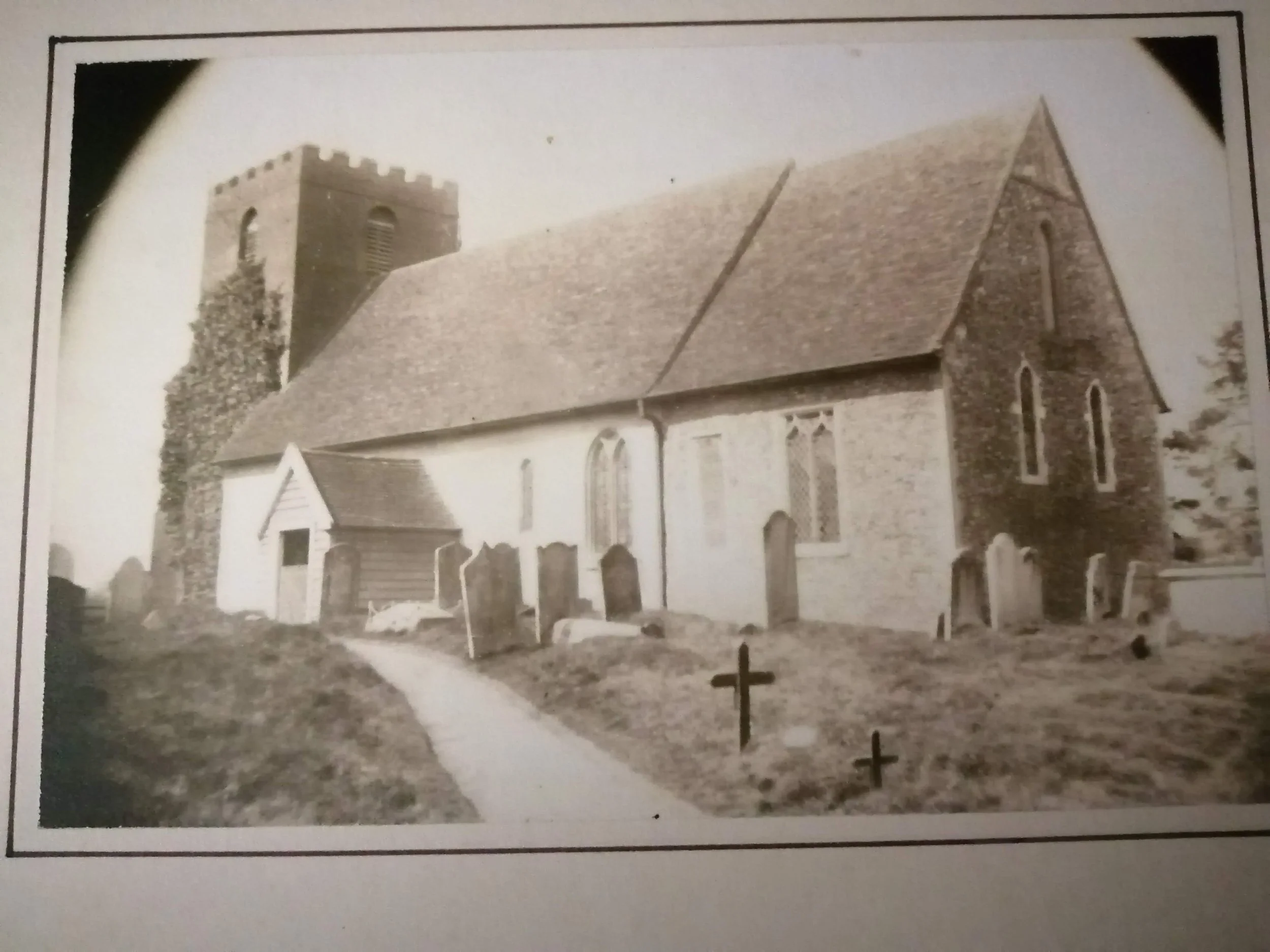
Timeline
St Mary the Virgin, Moreton, has been at the heart of our community for a thousand years; these are its notable dates and prominent patrons
c. 900 AD
c. 1000
c. 1066
1086
By 1172
1184 - 1335
1337
1337
1399
1414
1422
1441
1473
1532
1538/9
1548
1567
1581
c. 1610
1619
1658
1662
1687
1693
1786
1868/9
1993
Throughout lowland England, large estates began sub-dividing into villages. The lords and ladies of these communities desired a church of their own.
This led to a significant increase in the number of small local churches operated by single resident priests.
These smaller establishments - known as ‘field churches’ - acquired territories which they served and whose inhabitants owed them loyalty and dues. These became known as ‘parishes’.
A church in Moreton was built, probably by Sexi, a housecarl (freeman and household bodyguard) of King Edward the Confessor.
William de Scohies (also known as ‘de Escoiis’), notable landholder and an important tenant-in-chief to William of Normandy (King William 1, the ‘Conqueror’), acquires, from Sexi, the Manor of Moreton (including the church).
De Scohies gives Moreton church, with its land and assorted tithes, to the Abbey of St Etienne - founded in 1063 by William of Normandy and dedicated to St. Stephen - in Caen, France.
A chaplain’s house had been built near Moreton churchyard. (Whilst the bishop - or, later, prior - would have held official authority over the parish, in practice the cure of souls, in the form of spiritual guidance and care provided to nurture the spiritual well-being of parishioners, was delegated to the chaplain.)
A chaplain’s house had been built near Moreton churchyard. (Whilst the bishop - or, later, prior - would have held official authority over the parish, in practice the cure of souls, in the form of spiritual guidance and care provided to nurture the spiritual well-being of parishioners, was delegated to the chaplain.)
The church rebuilt
Construction of what is still the chancel (c.1220) and nave (c.1240) of the present building began in the first half of the13th century. (The ceiling restoration in 2002 showed the roof trusses to be from this period.)
Dating to this period, fragments of original painted decoration, in the form of a high-quality foliate scroll-work design at the top of the nave walls, are visible. (Similar motifs dating to this period are found inter alia at Cleeve Abbey in Somerset, Norwich Cathedral and parish churches in Sussex and Kent.)
Panfield, as with all alien priories (i.e., religious establishments in England under control of another religious house outside England), was taken into the hands of King Edward III who held the advowson(patronage) of Moreton church, i.e., the right to present the living (in effect, subject to the approval of the bishop, to choose the holder) for the office of vicar.
Accension of King Richard II, who retained the advowson.
Accension of King Henry IV, who retained the advowson.
By act of Parliament, smaller alien priories were dissolved and Panfield Priory and its possessions, including Moreton church, came to King Henry V.
King Henry VI succeeded to the throne and retained the advowson.
King Henry VI granted to the Provost of Eton College and to his successors an annual pension of 18 marks from the church, about £12. (A mark was worth 13 shillings and 4 pence.) The living remained in the gift of the Crown, which presented to the church as a vicarage.
Affiliated with St Mary’s, the Guild of All Saints, Moreton, was founded. The Guild met at Black Hall, in the heart of the village (a residence which remains in use today).
A religious fraternal society of the type common in the Middle Ages, guilds dedicated themselves to supporting their guildsmen (members) in devotional and temporal terms, including the saying of Masses and helping financially those who fell on hard times or who struggled in old age.
The church reformed
Holding the advowson, upgrading from a vicarage, King Henry VIII presented the living to the church as a rectory, the rector (‘incumbent’) having absolute ‘rule’ of his parish over both cure of souls and benefice rights, meaning the whole body of rights and revenues that came with the parish.
King Henry granted the advowson, first to Thomas Cranmer, Archbishop of Canterbury, and then to his brother-in-law, Charles Brandon, 1st Duke of Suffolk.
In turn, Brandon transferred ownership to Sir Richard Riche, formerly the Duke’s retainer and sometime land agent, who acted as go-between with the King a few years previously. At this time Riche was the Chancellor of the Court of Augmentations, responsible for the dissolution of all monasteries and other religious houses throughout England and Wales.
Due to the changes in practices of worship introduced during the reign of King Edward VI, as with all religious guilds, Moreton’s Guild of All Saints ceased to exist.
Around this time the wall paintings mentioned previously were likely painted over.
Sir Richard Riche, now 1st Baron Rich and Founder of Felsted School, died and the advowson passed to his son, Robert, 2nd Baron Rich.
The advowson passed to Robert, 3rd Baron Rich (and, in 1618, 1st Earl of Warwick).
During this period the church tower was built, described later as being made of ‘brick, plastered over, and with a shingled spire’.
The existing 12th century house used by the rector was rebuilt. The base of the massive chimney at the south end, visible from the road, may be part of the rectory of this time.
The advowson passed to Robert, 4th Baron Rich, 2nd Earl of Warwick. A committed Puritan and opponent of King Charles I, Rich was a close associate of Lord Protector Oliver Cromwell, whose daughter married Rich’s grandson and heir (another Robert!).
The advowson passed to Robert, 5th Baron Rich, 3rd Earl of Warwick.
The advowson passed to the 5th Baron Rich’s brother, Charles, 6th Baron Rich and 4th Earl of Warwick, who, as a young man, was noted for being handsome, charming, cheerful and penniless. On his death, in 1673, with no living children, the advowson passed to his nieces Anne, Mary and Essex, daughters of the 3rd Earl of Warwick.
Daniel Finch, 2nd Earl of Nottingham, husband of Essex Rich, the couple having married at the Rich family country seat of Leez Priory in 1674, secured the sole rights of patronage for Moreton church.
The advowson was purchased by St. John’s College, Cambridge, founded by charter in 1511 by Lady Margaret Beaufort, mother of the first Tudor monarch, King Henry VII.
Part of the tower fell in a storm and was rebuilt the following year.
A thorough restoration of the church’s interior was carried out.
The living for Moreton was united with that of Little Laver, being in the gift of St John’s College, who had first and third turns of appointment, shared with the Bishop of Chelmsford, who had second turn.
At some point, after 1936, St John's relinquished the advowson of the church into the possession of the Bishop of Chelmsford who now has sole right to the presentation of the living.